This chapter is based on pp. 153-179 of Origin of the Universe (Volume One of
our three-volume Evolution Disproved Series). Not included in this chapter are
at least 15 statements by scientists. You will find them, plus much more, on our
website: evolution-facts.org.
How old is Planet Earth?
This is an important question. Even though long ages of time are not a proof of
evolution, yet without the long ages evolution could not occur (if it were
possible for it to occur).
Actually, there are many evidences
that our world is quite young. Here are some of them:
First we shall consider EVIDENCE FROM THE STARS that the universe
itself is quite young:
1 - STAR CLUSTERS—There
are many star clusters in the universe. Each one is a circular ball composed of
billions upon billions of stars, each with its own orbit. Science tells us that
some of these clusters—with their stars—are moving so rapidly, together, in a
certain direction that it should be impossible for them to remain together if
the universe were very old.
2 - LARGE STARS—Some
stars are so enormous in diameter that it is thought that they could not have
existed for even a few million years, otherwise their initial larger mass would
have been impossibly large.
These massive stars radiate energy very rapidly—some as much as 100,000 to 1
million times more rapidly than our own sun. On the hydrogen basis of stellar
energy, they could not have contained enough hydrogen to radiate at such fast
rates for long ages, because their initial mass would have had to be far too
gigantic.
3 - HIGH-ENERGY STARS—Some
stars are radiating energy so intensely that they could not possibly have
survived for a long period of time.
This includes the very bright O and B class stars, the Wolf-Rayfert
stars, and the P Cygni stars. Radiation levels of 100,000 to 1
million times as much as our own sun are emitted by these stars! Yet, by the
standard solar energy theory, they do not contain enough hydrogen to perpetuate
atomic fusion longer than approximately 50,000 to 300,000 years.
4 - BINARY STARS—Many
of the stars in the sky are binaries: two stars circling one another. But
many of these binary systems point us to a young age for the universe, because
they consist of theoretically "young" and "old" stars circling one another.
5 - HYDROGEN IN UNIVERSE—According
to one theory of solar energy, hydrogen is constantly being converted into
helium as stars shine. But hydrogen cannot be made by converting other elements
into it. *Fred Hoyle, a leading astronomer, maintains that, if the universe
were as old as Big Bang theorists contend, there should be little hydrogen in
it. It would all have been transformed into helium by now. Yet stellar
spectra reveal an abundance of hydrogen in the stars, therefore the universe
must be youthful.
Next we shall consider EVIDENCE FROM OUR SOLAR SYSTEM that our solar
system is quite young:
6 - SOLAR COLLAPSE—Research
studies indicate that our sun is gradually shrinking at a steady rate of seconds
of arc per century. At its rate of shrinkage, as little as 50,000 years ago
the sun would have been so large that our oceans would boil. But in far less a
time than 50,000 years, life here would have ceased to exist. Recent studies
have disclosed that neither the size of the sun, nor our distance from it, could
be much greater or smaller—in order for life to be sustained on our planet.
"By analyzing data from Greenwich Observatory in the period 1836-1953, John A.
Eddy [Harvard-Smithsonian Center for Astrophysics and High Altitude Observatory
in Boulder] and Aram A. Boornazian [mathematician with S. Ross and Co. in
Boston] have found evidence that the sun has been contracting about 0.1% per
century during that time, corresponding to a shrinkage rate of about 5 feet per
hour. And digging deep into historical records, Eddy has found 400-year-old
eclipse observations that are consistent with such a shrinkage."— *"Sun is
Shrinking," Physics Today, September 1979.
Extrapolating back, 100,000 years ago, the sun would have been about twice its
present size, making life untenable.
7 - SOLAR NEUTRINOS—In
1968 it was discovered that the sun is emitting hardly any neutrinos. This
evidence points directly to a very youthful sun. These neutrinos ought to be
radiating outward from the sun in very large amounts, but this is not occurring.
This fact, coupled with the discovery that the sun is shrinking in size, point
to a recently created sun.
8 - COMETS—Comets,
journeying around the sun, are assumed to have the same age as our world and
solar system. But, as *Fred Whipple has acknowledged, astronomers have no idea
where or how comets originated. Yet we know that they are continually
disintegrating. This is because they are composed of bits of rocky debris held
together by frozen gases and water. Each time a comet circles the sun, some
of the ice is evaporated and some of the gas is boiled away by the sun’s heat.
Additional material is lost through gravitational forces, tail formation, meteor
stream production, and radiative forces. The most spectacular part of a comet is
its tail, yet this consists of material driven away from its head by solar
energy. All the tail material is lost in space as the comet moves onward.
A number of comets have broken up and dissipated within the period of human
observation. Some of those regularly seen in the nineteenth century have now
vanished. Others have died spectacularly by plunging into the sun.
Evidently all the comets should self-destruct within a time frame that is fairly
short.
Careful study has indicated that the effect of this dissolution process on
short-term comets would have totally dissipated them within 10,000 years.
There are numerous comets circling our sun, including many short-term ones, with
no source of new comets known to exist.
9 - COMET WATER—It
has only been in recent years that scientists have discovered that comets are
primarily composed of water, and that many small comets are continually
striking the earth. Yet each strike adds more water to our planet.
Scientific evidence indicates that, if the earth was billions of years old, our
oceans would be filled several times over with water.
10 - SOLAR WIND—As
the sun’s radiation flows outward, it applies an outward force on very, very
small particles orbiting the sun. All of the particles smaller than 100,000th of
a centimeter in diameter should have long ago been "blown out" of our solar
system,
if the solar system were billions of years old. Yet research studies by
satellites in space have shown that those small particles are abundant and still
orbiting the sun. Therefore our solar system is quite young.
11 - SOLAR DRAG—This
is a principle known as the "Poynting-Robertson Effect." Our sun
exerts a solar drag on the small rocks and larger particles
(micrometeoroids) in our solar system. This causes these particles to
spiral down into the sun and be destroyed. The sun, acting like a giant
vacuum cleaner, sweeps up about 100,000 tons [82,301 mt] of micrometeoroids each
day. The actual process by which this occurs has been analyzed. Each particle
absorbs energy from the sun and then re-radiates it in all directions. This
causes a slowing down of the particle in its orbit and causes it to fall into
the sun. At its present rate, our sun would have cleaned up most of the
particles in less than 10,000 years, and all of it within 50,000 years.
Yet there is an abundance of these small pieces of rock, and there is no known
source of replenishment. This is because each solar system would lock in its own
micrometeoroids, so they could not escape to another one; and the gravity on
each planet and moon would forbid any of its gravel to fly out into space.
Next we shall consider EVIDENCE FROM THE OTHER PLANETS IN OUR SOLAR SYSTEM
that the solar system is
quite young:
12 - COMPOSITION OF SATURN’S RINGS—*G.P.
Kuiper reported, in 1967, that the trillions of particles in the rings
circling the planet Saturn are primarily composed of solid ammonia. Since
solidified ammonia has a much higher vapor pressure than even ice, reputable
scientists recognize that it could not survive long without vaporizing off into
space. This is a strong indicator of a young age for Saturn’s rings.
13 - BOMBARDMENT OF SATURN’S RINGS—Meteoroids
bombarding Saturn’s rings would have destroyed them
in far less than 20,000 years.
14 - MORE RING PROBLEMS—NASA
Voyager treks have disclosed that Jupiter and Uranus also have rings encircling
them! (In addition, a 1989 Neptune flyby revealed that it also has rings—four of
them.) These discoveries have only augmented the problem of the evolutionists;
for this would indicate a young age for those three planets also.
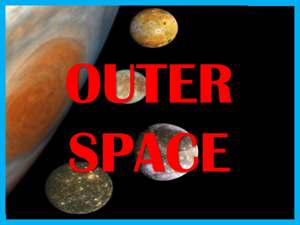
15 - JUPITER’S MOONS—The
Voyager I space probe was launched on September 5, 1977. Aimed at the planet
Jupiter, it made its closest approach to that planet on March 5, 1979. Thousands
of pictures and thousands of measurements were taken of Jupiter and its moons.
Io is the innermost of the four original "Galilean moons," and was found
to have over sixty active volcanoes!
These volcanoes spew plumes of ejecta from 60 to 160 miles [97 to 257 km] above
Io’s surface. This is astounding.
Nothing on our planet can match this continuous stream of material being shot
out by Io’s volcanoes at a velocity of 2,000 miles per hour [3218 km per hour]!
The usual evolutionary model portrays all the planets and moons as being molten
5 billion years ago. During the next billion years they are said to have had
active volcanoes. Then, 4 billion years ago, the volcanism stopped as they
cooled. Io is quite small; yet it has the most active volcanoes we know of.
Obviously, it is quite young and its internal heat has not had time to cool.
16 - MOONS TOO DIFFERENT—If
all four moons of Jupiter’s "Galilean moons" evolved, they should be essentially
alike in physical characteristics.
The theorized millions of years they have existed should cause them to have the
same amount of volcanoes and impact craters, but this is not so. In contrast, a
recent Creation would explain Io’s volcanoes and the variety of other surface
features.
Next we shall consider EVIDENCE FROM OUR OWN MOON that it is quite
young:
17 - MOON DUST—Although
most people do not know it, one of the reasons so much money was spent to send a
rocket to the moon was to see how thick the dust was on its surface!
Evolutionists had long held to the fact (as we do) that the earth and moon are
about the same age. It is believed, by many, that the earth and its moon are
billions of years old. If that were true, the moon would by now have built up
a 20-60 mile [32 to 97 km] layer of dust on it!
In *Isaac Asimov’s first published essay (1958), he wrote:
" . . I get a picture, therefore, of the first spaceship [to the moon], picking
out a nice level place for landing purposes, coming slowly downward tail-first
and sinking majestically out of sight."—*Isaac Asimov, Asimov on Science:
A Thirty-Year Retrospective (1989), xvi-xvii.
In the 1950s, *R.A. Lyttleton, a highly respected astronomer, said this:
"The lunar surface is exposed to direct sunlight, and strong ultraviolet light
and X-rays [from the sun] can destroy the surface layers of exposed rock and
reduce them to dust at the rate of a few ten-thousandths of an inch per year.
But even this minute amount could, during the age of the moon, be sufficient to
form a layer over it several miles deep."—*R.A. Lyttleton, quoted in R.
Wysong, Creation-Evolution Controversy, p. 175.
In 5 to 10 billion years, 3 or 4/10,000ths of an inch per year would produce
20-60 miles [32-97 km] of dust. In view of this, our men at NASA were afraid to
send men to the moon. Landing there, they would be buried in dust and quickly
suffocate! So NASA first sent an unmanned lander to its surface, which made the
surprising discovery that there was hardly any dust on the moon! In spite of
that discovery, Neil Armstrong was decidedly worried about this dust problem as
his July 1969 flight in Apollo 11 neared. He feared his lunar lander would sink
deeply into it and he and Edwin Aldrin would perish. But because the moon is
young, they had no problem. There is not over 2 or 3 inches [5.08 or 7.62 cm]
of dust on its surface! That is the amount one would expect if the moon were
about 6000-8000 years old.
*Dr. Lyttleton’s facts were correct; solar radiation does indeed turn the moon
rocks into dust. With only a few inches of dust, the moon cannot be older than a
few thousand years.
It is significant that studies on the moon have shown that only 1/60th of the
one- or two-inch dust layer on the moon originated from outer space. This
has been corroborated by still more recent measurements of the influx rate of
dust on the moon, which also do not support an old moon.
18 - LUNAR SOIL—Analysis
of lunar soil negates the possibility of long ages for the moon’s existence.
The dirt on the moon does not reveal the amount of soil mixing that would
be expected if the moon were very old.
19 - LUNAR ISOTOPES—Many
wonder what value there has been in collecting moon rocks. One of the most
surprising moon rock discoveries is seldom mentioned: Short-lived Uranium 236
and Thorium .230 were found in those stones! Short-term radioactive isotopes do
not last long; they quickly turn into their end product, which is lead. If the
moon were even 50,000 years old, these short-life radioisotopes would long since
have decayed into lead. But instead they were relatively abundant in the
moon rocks! The importance of this should not be underestimated. The moon cannot
be older than several thousand years.
20 - LUNAR RADIOACTIVE HEAT—Rocks
brought by Apollo teams from the moon have been dated by the various radiometric
methods. A variety of very conflicting dates have resulted from these tests.
But the factor of relatively high radioactivity of those rocks indicates a young
age for the moon.
21 - LUNAR GASES—Several
inert gases have been found on the surface of the moon. Scientists believe
that these gases came from the sun, in the form of "solar wind."
Mathematical calculation reveals that, at today’s intensity of solar wind, the
amount of inert gases found on the moon would be built up in 1,000 to 10,000
years, —and no longer. These calculations are based on Argon 36 and Krypton
84 concentrations. Even 20,000 years ago would be far too lengthy a time.
Therefore the moon could not be older than about 6,000-10,000 years.
22 - LUNAR PHENOMENA—A
growing collection of data of transient lunar activity (moon quakes, lava flows,
gas emissions, etc.) reveals that the moon is not a cold, dead body. It is still
adjusting to inner stresses and is not yet in thermal equilibrium. Yet, all
things considered, if the moon were very old it should not show such thermal
activity.
23 - LUNAR RECESSION—Scientists
have discovered two interesting facts: (1) The moon is already far too close
to the earth, and (2) it is gradually moving farther away from us.
This is called recession of the moon. Due to tidal friction, the moon is
slowly spiraling outward away from planet earth! Based on the rate at which the
moon is receding from us, the earth and the moon cannot be very old. This is an
important point and can in no way be controverted. The present rate of recession
clearly indicates a young age for the earth-moon system. If the moon were
older—even 20 to 30,000 years old,—it would at that earlier time have been so
close that it would have fallen into the earth!
"The moon is slowly receding from Earth at about 4 cm [1½ in] per year, and the
rate would have been greater in the past. The moon could never have been closer
than 18,400 km [11,500 miles], known as the Roche Limit, because Earth’s
tidal forces would have shattered it."—Jonathan Sarfati, Creation Ex Nihilo,
September 1979.
Next we shall consider EVIDENCE FROM THE ATMOSPHERE that the earth is
quite young:
24 - ATMOSPHERIC HELIUM—The
radioactive decay of either uranium or thorium produces helium. According to
evolutionary theory, these decay chains have been going on for billions of
years, and should therefore have produced a much larger quantity of helium than
is found in our world. The amount of helium on our planet is far too small,
if our world has existed for long ages.
"There ought to be about a thousand times as much helium in the atmosphere as
there is."—*"What Happened to the Earth’s Helium?" New Scientist, 24,
December 3, 1964.
To fit the evolutionary pattern, our atmosphere would now have to contain much
more than our present 1.4 parts per million of helium. Some evolutionists
have suggested that the helium is escaping out into space, but no evidence has
ever been found to substantiate this. Research has shown that, although
hydrogen can escape from the earth, helium is not able to reach "escape
velocity." In order to do so, the temperature of the planet would have to be too
high to support the life that evolutionists say has been here for over a billion
years.
To make matters worse, not only are we not losing helium to outer space—we are
getting more of it from there! *Cook has shown that helium, spewed out by the
sun’s corona, is probably entering our atmosphere (Melvin A. Cook, "Where is
the Earth’s Radiogenic Helium?" Nature 179, January 26, 1957).
Atmospheric helium is produced from three sources: (1) radioactive decay of
uranium and thorium. (2) Cosmic helium flowing into our atmosphere from space,
but especially the sun’s corona. (3) Nuclear reactions in the earth’s crust,
caused by cosmic ray bombardment.
Kofahl and Segraves conclude that, using all three helium sources in the
calculation, earth’s atmospheric age would be reduced to 10,000 years.
In addition to this, a worldwide catastrophic event in the past such as the
Flood could, for a short time, have unleashed much larger amounts of helium into
the atmosphere. Such an event could significantly reduce the total atmospheric
age. Helium con
tent is a good measure, since there is no known way it can escape from the
atmosphere into outer space.
Also see Larry Vardiman, The Age of the Earth’s Atmosphere: A Study of the
Helium Flux through the Atmosphere (1990), in which he argues that, on the
basis of atmospheric helium content, the earth cannot be over 10,000 years old.
25 - CARBON-14 DISINTEGRATION—The
present worldwide buildup of radiocarbon in the atmosphere would have produced
all the world’s radiocarbon in several thousand years.
Yet, ironically, it is Carbon 14 that is used by evolutionist scientists in an
attempt to prove that life has existed on our planet for millions of years!
Robert Whitelaw, a nuclear and engineering expert at Virginia Polytechnic
Institute, found that the production rate is not equal to the disintegration
rate. In fact, his calculations reveal a recent turning on of the C-14
clock,—otherwise the two factors would be balanced. Whitelaw’s research
indicates that the clock was turned on approximately 8,000 years ago. (See
chapter 6, Inaccurate Dating Methods, for more on radiocarbon dating.)
Next we shall consider EVIDENCE FROM METEORITES that the earth is
quite young:
26 - METEOR DUST—Meteors
are continually hurtling into the atmosphere and landing on our planet. They are
then known as meteorites. But small amounts of meteor dust (called
micrometeors and too small to see) also enter our atmosphere and
gradually settle to earth. The composition of these materials is iron, nickel,
and silicate compounds.
On the average, about 20 million meteors collide with the earth’s atmosphere
every 24 hours.
It is now known that, because of meteorites and meteorite dust, the earth
increases in weight by about 25 tons [22.7 mt] each day.
We have here another evidence of a young earth; forthe amount of meteorites
and meteorite dust earlier accumulated in rock strata, in relation to the
amounts reaching the earth at present, would indicate an age in thousands of
years, not millions.
27 - METEOR CRATERS—Meteor
craters are fairly easy to locate, especially since we now have such excellent
aerial and satellite mapping systems. For example, the meteor crater near
Winslow, Arizona, is ¾ mile [1.2 km] in diameter and 600 feet [1,829 dm]
deep. Efforts have been made to locate meteor craters in the rock strata, but
without success. They always lie close to or on the surface. This and erosional
evidence indicate that all the meteor craters which have struck the earth are
all only a few thousand years old. No larger meteors struck the earth prior
to that time, for no meteor craters are found anywhere in the lower rocks.
28 - METEOR ROCKS—Meteors
of various types are continually plunging into earth’s atmosphere, and some
reach the surface and are then called meteorites. Supposedly this has
happened for millions of years—yet all the meteorites discovered are always
right next to the earth’s surface! There are no exceptions! No meteorites are
ever found in the deeper ("older") sedimentary strata. If the earth were very
ancient, many should be found farther down. This is an evidence of a young
earth. It is also an indication that the sedimentary strata was rather quickly
laid down not too long in the past.
"No meteorites have ever been found in the geologic column."—*Fred Whipple,
"Comets," in The New Astronomy, p. 207.
*Asimov’s theory is that "crustal mixing" has removed all trace of the
meteorites. But the nickel from those meteorites should still be there littering
the earth’s surface and to be found beneath it. But this is not the case.
"For many years, I have searched for meteorites or meteoric material in
sedimentary rocks [the geological strata] . . I have interviewed the late Dr.
G.P. Merrill, of the U.S. National Museum, and Dr. G.T. Prior, of the British
Natural History Museum, both well-known students of meteorites, and neither man
knew of a single occurrence of a meteorite in sedimentary rocks."—*W.A. Tarr,
"Meteorites in Sedimentary Rocks?" Science 75, January 1932.
29 - TEKTITES—Tektites
are a special type of glassy meteorite.
Large areas containing them are called "strewn fields." Although some
scientists claim that tektites are of earthly origin, there is definite evidence
that they are actually meteorites.
Every so often, a shower of tektites falls to the earth. The first were found in
1787 in what is now western Czechoslovakia. Those in Australia were found in
1864. They were given the name tektites, from a Greek word for "molten,"
because they appear to have melted in their passage through the atmosphere.
Tektites have also been found in Texas and several other places. Each shower
lies on the surface or in the topmost layers of soil; they are never found in
the sedimentary fossil-bearing strata. If the earth were 5 billion years
old, as suggested by evolutionists, we should expect to find tektite showers in
all the strata. If the earth is only a few thousand years old, and a Flood
produced all the strata, we would expect to find the tektites only in the
topmost layers of the ground and not in the deeper strata. And that is where
they are.
The tektites are found on top of, what evolutionary theory calls, "recent" soil,
not beneath it. The evidence is clear that the tektites did not work their way
up from beneath or wash down from older sediments at a higher elevation.
Next we shall consider EVIDENCE FROM THE GLOBE that the earth
is quite young:
30 - EARTH ROTATION—The
spin of the earth—which is now about 1,000 miles [1609 km] an hour—is gradually
slowing down.
Gravitational drag forces of the sun, moon, and other factors cause this. If the
earth were really billions of years old, as claimed, it would already have
stopped turning on its axis! This is yet another evidence that our world is not
very old.
Lord Kelvin (the 19th-century physicist who introduced the Kelvin temperature
scale) used this slowing rotation as a reason why the earth could not be very
old. The decline in rotation rate is now known to be greater than previously
thought (Thomas G. Barnes, "Physics: A Challenge to ‘Geologic Times,’ "
Impact 16, July 1974).
Using a different calculation, we can extrapolate backward from our present spin
rate; and 5 billion years ago our planet would have had to be spinning so fast
it would have changed to the shape of a flat pancake. We, today, would still
have the effects of that: Our equator would now reach 40 miles [64 km] up into
the sky, and our tropical areas—and all our oceans—would be at the poles. So, by
either type of calculation, our world cannot be more than a few thousand years
old.
31 - MAGNETIC FIELD DECAY—As
you probably know, the earth has a magnetic field. Without it, we could
not use compasses to identify the direction of magnetic north (which is close to
the North Pole). Dr. Thomas G. Barnes, a physics teacher at the University of
Texas, has authored a widely used college textbook on electricity and magnetism.
Working with data collected over the past 135 years, he has pointed out that
earth’s magnetic field is gradually decaying. Indeed, he has shown that
this magnetic field is decreasing exponentially, according to a decay law
similar to the decay of radioactive substances.
In 1835 the German physicist, K.F. Gauss, made the first measurement of the
earth’s magnetic dipole moment; that is, the strength of earth’s internal
magnet. Additional evaluations have been carried out every decade or so since
then. Since 1835, global magnetism has decreased 14 percent!
On the basis of facts obtained from 1835 to 1965, this magnetic field appears to
have a half-life of 1,400 years. On this basis, even 7,000 years ago, the earth
would have had a magnetic field 32 times stronger than it now has. Just 20,000
years ago, enough Joule heat would have been generated to liquefy the earth. One
million years ago the earth would have had greater magnetism than all objects in
the universe, and it would have vaporized! It would appear that the earth could
not be over 6,000 or 7,000 years old. (On the accompanying graph, beyond the
point where the curve becomes vertical, our planet would have had the
magnetosphere power of a magnetic star!)
"The over-all intensity of the field is declining at a rate of 26 nanoteslas per
year . . If the rate of decline were to continue steadily, the field strength
would reach zero in 1,200 years."—*"Magnetic Field Declining," Science News,
June 28, 1980.
"In the next two millennia, if the present rate of decay is sustained, the
dipole component of the [earth’s magnetic] field should reach zero."—*Scientific
American, December 1989.
This magnetic decay process is not a local process, such as one would find in
uranium, but worldwide; it affects the entire earth. It has been accurately
measured for over 150 years, and is not subject to environmental changes since
it is generated deep in the earth’s interior.
If any fundamental planetary process ought to be a reliable indicator of the
earth’s age, it should be our earth’s magnetic field—and
it indicates an upper limit of decidedly less than 10,000 years for the age of
the earth.
Most of the factors described above would apply to the age of the earth, which
appears to be decidedly less than 10,000 years.
Most of the following items of evidence would apply to the length of time since
the Flood, which evidence indicates may have occurred about 4350 years ago.

The Evolution Handbook contains over 3,000 scientific facts which annihilate the
theory of evolution. Available in boxes of 16 for $1.00 each at
http://www.evolution-facts.org/Handbook TOC.htm
CLICK HERE for link to
the Evolution Handbook online:
http://www.evolution-facts.org/Downloads.htm
CLICK HERE to return to the CREATION INDEX
Aol users must request information by using the following email:
OTHER INDEX FILES: